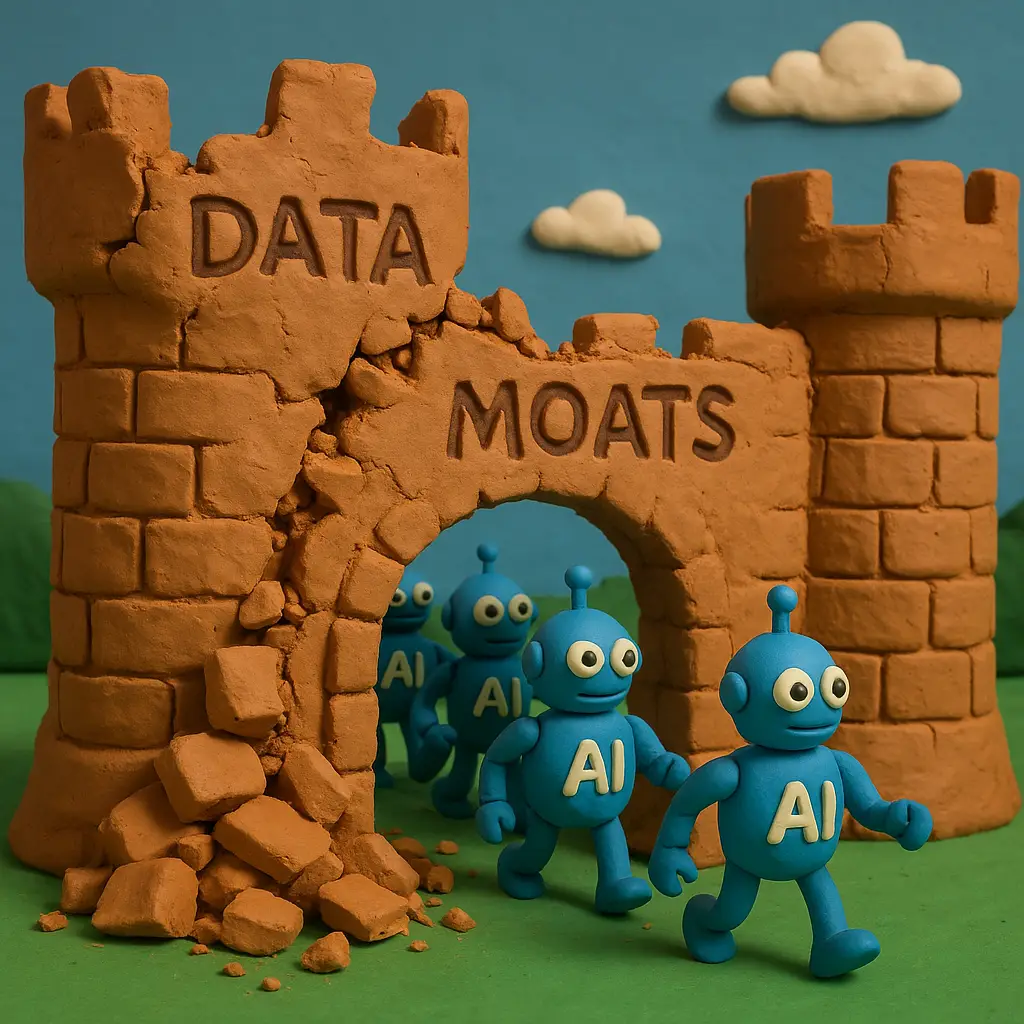
The defensible business advantages everyone spent a decade building just became commodities overnight.
“We have the data advantage,” the CEO declares confidently. “Our competitors can’t match our dataset. That’s our moat.”
I’ve heard this in boardrooms from San Francisco to London. It was compelling logic for the past decade. Build the biggest dataset. Guard it fiercely. Use it to train better models. Win.
That playbook just became obsolete.
Not gradually. Not over the next few years. Right now. The data moats that companies spent billions building are evaporating faster than venture capital in a bear market.
The Great Data Democratization
Foundation models changed everything. When GPT-4 can reason about complex problems using training data from across the internet, your proprietary customer dataset stops being a castle wall and starts looking like a speed bump.
Synthetic data generation is the final nail in the coffin. Why scrape years of customer interactions when you can generate thousands of realistic scenarios in hours? Why wait for edge cases to occur naturally when you can synthesize them on demand?
Google’s latest research shows synthetic data often outperforms real data for training AI models. Not matches—outperforms. The scarcity that made your data valuable is artificial scarcity, and artificial intelligence just made it irrelevant.
Consider what happened to translation services. Companies like SDL and Lionbridge built massive competitive advantages around proprietary linguistic datasets. Then Google Translate became good enough for most use cases using publicly available training data. Now, foundation models handle translation as a side effect of general intelligence.
Your industry-specific dataset is heading toward the same fate.
The Commoditization Cascade
Every competitive advantage in AI follows a predictable path:
- Breakthrough capability emerges
- Early adopters gain temporary advantage
- Capability becomes accessible to more players
- Advantage commoditizes
We’re watching this happen in real-time across AI capabilities:
Computer Vision: Once required PhD teams and massive labeled datasets. Now available as APIs for $0.002 per image.
Natural Language Processing: Previously needed armies of linguists and custom models. Now foundation models handle it as a basic function.
Predictive Analytics: Used to require specialized data science teams. Now accessible through no-code ML platforms.
The cycle is accelerating. Capabilities that took years to develop can be replicated in weeks. Competitive advantages that felt permanent evaporate in quarters.
Data advantages are just the latest casualty in this commoditization cascade.
Why “More Data” Is the Wrong Strategy
The instinctive response to AI democratization is “we need more data.” Companies are doubling down on data collection, launching data lakes, hiring chief data officers.
This is exactly wrong. More data doesn’t create more advantage—it creates more liability.
Every additional data point is another privacy concern, another security risk, another compliance headache. Meanwhile, foundation models get better at reasoning with less data, not more.
The companies winning in AI aren’t those with the most data. They’re those with the best data utilization—the ability to extract maximum insight from minimal information and apply it faster than competitors can react.
Quality trumps quantity. Speed trumps scale. Insight trumps information.
The New Competitive Advantages
If data moats are dead, what replaces them? The companies pulling ahead in the AI era are building advantages around different vectors entirely:
Execution Velocity
While competitors debate AI strategies in quarterly planning cycles, winners ship AI features weekly. The advantage isn’t having better AI—it’s having AI capabilities live in production while others are still in pilot phases.
Tesla’s Autopilot advantage illustrates this perfectly. Yes, they have massive datasets from millions of vehicles. But their real moat is the compounding effect of real-time data collection combined with rapid deployment capability. Every Tesla on the road continuously feeds edge cases and driving scenarios back to their AI systems, while their over-the-air update infrastructure lets them push improvements to the entire fleet overnight. Traditional automakers might have access to similar AI capabilities, but they can’t match Tesla’s closed-loop learning system or their speed of deployment.
AI-Human Integration
The magic happens at the intersection of artificial intelligence and human expertise. Companies that crack this integration create advantages that can’t be replicated by simply buying better AI models.
Stripe’s fraud detection isn’t superior because they have better transaction data. It’s superior because they’ve built the tightest feedback loops between AI predictions and human review, creating a learning system that improves faster than pure-AI approaches.
Compound Intelligence
Individual AI capabilities commoditize quickly. But unique combinations of AI capabilities, carefully orchestrated, create emergent advantages that are harder to replicate.
Netflix’s recommendation advantage isn’t their viewing data—it’s the compound system that combines content analysis, user behavior prediction, thumbnail personalization, and streaming optimization into an integrated experience.
Contextual Adaptation
Generic AI capabilities are table stakes. The advantage comes from AI that understands and adapts to specific contexts, workflows, and business logic.
Salesforce’s Einstein isn’t just CRM with AI sprinkled on top. It’s AI that understands sales processes, lead scoring contexts, and customer journey nuances that generic AI can’t replicate.
The Speed Advantage
In a world where AI capabilities democratize rapidly, the only sustainable advantage is speed—speed of implementation, speed of iteration, speed of learning.
This isn’t just about technology velocity. It’s about organizational velocity. The ability to identify opportunities, make decisions, and execute changes faster than the rate of AI commoditization.
Companies optimizing for speed are building:
- Rapid prototyping capabilities
- Fast feedback loops with customers
- Agile AI development processes
- Quick decision-making structures
While others perfect their AI strategies, speed-optimized companies are on their third iteration of AI implementation.
The Uncomfortable Reality
Your data scientists won’t want to hear this. Your chief data officer definitely won’t. The expensive data infrastructure you’ve built over the past decade feels too valuable to abandon.
But the most dangerous phrase in business is “that’s not how we’ve always done it.” Data advantages were real for a specific period of technological development. That period is ending.
The companies thriving in the AI-everything world won’t be those with the best data. They’ll be those who recognized earliest that competitive advantage shifted from information hoarding to intelligence application.
What This Means for Your Strategy
Stop asking “How do we get more data?” Start asking “How do we get better outcomes with the data we have?”
Stop building data moats. Start building execution moats.
Stop protecting your datasets. Start perfecting your ability to turn insights into action faster than anyone else.
The data advantage era is over. The execution advantage era has begun.
The question isn’t whether you have enough data to compete. It’s whether you can move fast enough to matter.
Ready to shift from data hoarding to execution acceleration? Let’s explore what competitive advantage looks like in the post-data world.