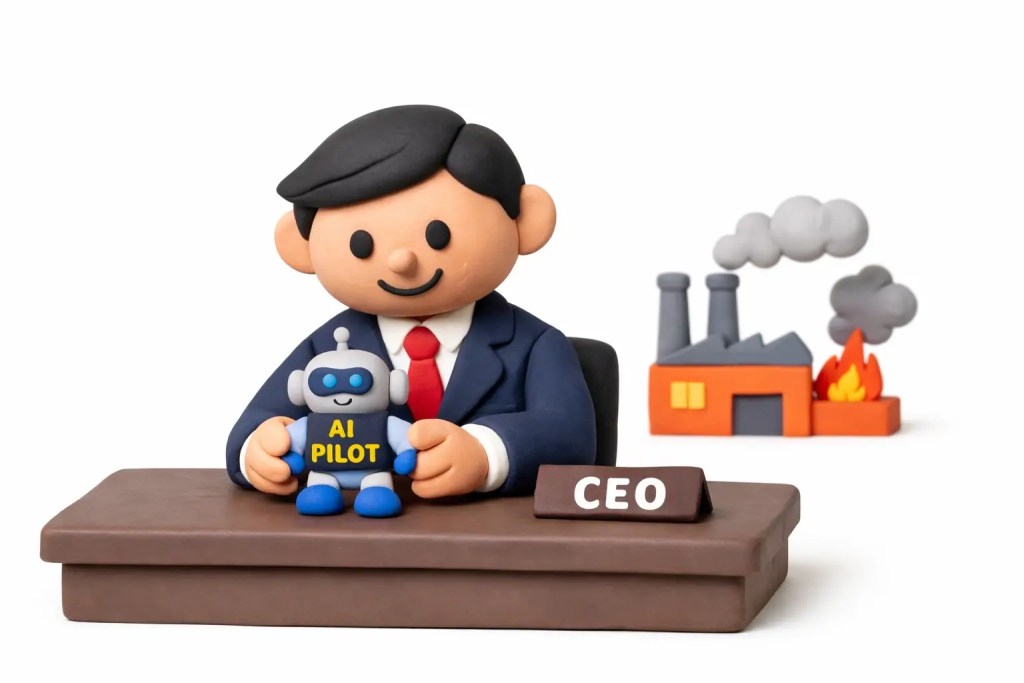
Creating a separate AI function is the fastest way to ensure AI never transforms your business.
The press release writes itself: “Leading enterprise announces appointment of Chief AI Officer to spearhead digital transformation and drive AI innovation across the organization.”
The board feels confident. The investors are impressed. The new hire has an impressive résumé and a compelling vision.
Six months later, the Chief AI Officer is frustrated, the organization is confused, and AI initiatives are stalled in committee purgatory.
This story is repeating across enterprises worldwide. Companies are hiring Chief AI Officers faster than they hired Chief Digital Officers a decade ago, expecting a single executive to solve their AI transformation challenges.
It’s not working. It can’t work. And it’s actually making AI transformation harder.
The Silo Trap
Here’s what happens when you create a Chief AI Officer role: You’ve just told every other executive that AI is someone else’s job.
The CMO stops thinking about AI-powered customer experiences because “that’s the CAO’s domain.” The CFO defers AI-driven financial modeling because “the AI team handles that.” The COO avoids AI-enabled operations improvements because “we should coordinate with the Chief AI Officer first.”
Instead of accelerating AI adoption, you’ve created an organizational bottleneck disguised as leadership.
AI transformation requires every function to reimagine their processes, tools, and outcomes. When you designate a single owner, you’re actually designating everyone else as non-owners.
The most successful AI transformations happen when AI becomes integral to every executive’s mandate, not isolated in a separate function.
The Expertise Mirage
“We need someone who really understands AI,” boards explain when justifying the Chief AI Officer hire. This sounds logical until you examine what AI expertise actually means in an enterprise context.
Technical AI knowledge? Your engineering teams likely know more about model architectures and training processes than any C-suite executive ever will.
Business AI strategy? This requires deep understanding of your specific industry, customer base, and operational constraints—knowledge that can’t be imported from external AI experts.
AI implementation? This demands expertise in change management, organizational design, and cross-functional coordination—classic general management skills, not AI-specific capabilities.
The expertise that matters most for AI transformation isn’t AI expertise—it’s business transformation expertise applied to AI opportunities.
The Innovation Theater Problem
Chief AI Officers face enormous pressure to show immediate results. This pressure drives them toward visible, flashy AI projects rather than foundational AI capabilities.
We get AI chatbots instead of AI-powered decision systems. We get innovation labs instead of AI-integrated workflows. We get pilot projects instead of production transformations.
The CAO becomes the Chief AI Demo Officer, constantly showcasing AI possibilities while the core business operates unchanged.
Meanwhile, real AI transformation—the unglamorous work of rebuilding processes, retraining teams, and rethinking workflows—gets delayed because it doesn’t generate impressive quarterly updates for the board.
The Authority Paradox
Chief AI Officers need authority to drive transformation but lack the positional power to actually transform anything.
They can’t restructure the sales organization to leverage AI-powered lead scoring—that’s the Chief Revenue Officer’s domain. They can’t redesign financial processes to incorporate AI-driven forecasting—that belongs to the CFO. They can’t reimagine customer service workflows around AI capabilities—that’s the Chief Customer Officer’s territory.
The CAO becomes a coordinator without authority, an advisor without decision rights, a transformer without transformation power.
Successful AI implementation requires executives with profit-and-loss responsibility to make AI integral to their business results. Chief AI Officers, by definition, sit outside these decision-making structures.
The Distraction Factor
While the Chief AI Officer focuses on AI strategy, the actual business leaders focus on business results. This creates a fundamental misalignment that dooms AI initiatives.
The CAO presents an AI roadmap for customer personalization. The CMO, facing quarterly revenue pressure, opts for proven marketing tactics instead. The AI strategy becomes a future consideration while business leaders optimize for immediate results.
Without direct connection between AI capabilities and business outcomes, AI remains a strategic aspiration rather than operational reality.
The most effective AI transformations happen when business leaders see AI as the fastest path to their business objectives, not as a separate strategic initiative competing for resources and attention.
What Actually Works: Distributed AI Ownership
Instead of centralizing AI ownership in a single role, successful companies distribute AI accountability across their existing leadership structure:
The CEO sets AI transformation as a strategic imperative and ties executive compensation to AI integration success.
The CTO ensures technical infrastructure supports AI capabilities and manages AI security and compliance requirements.
The Chief Revenue Officer owns AI-powered sales processes, lead scoring, and customer acquisition optimization.
The Chief Marketing Officer drives AI-enabled personalization, content optimization, and customer experience improvements.
The Chief Operations Officer implements AI-driven process automation, supply chain optimization, and operational efficiency gains.
The CFO leverages AI for financial forecasting, risk assessment, and performance analytics.
Each executive owns AI outcomes within their domain while a cross-functional AI council coordinates shared capabilities and prevents duplicated efforts.
The Coordination Model
If not a Chief AI Officer, how do you coordinate AI initiatives across functions?
AI Center of Excellence: A small team that provides AI capabilities, training, and best practices to business units without owning business outcomes.
Cross-Functional AI Council: Regular forums where business leaders share AI learnings, coordinate shared investments, and align on AI standards.
Embedded AI Teams: AI specialists embedded within business functions, reporting to functional leaders but sharing knowledge across the organization.
AI Vendor Management: Centralized evaluation and management of AI tools and platforms while leaving implementation decisions to business units.
This model accelerates AI adoption because business leaders own AI outcomes directly rather than delegating them to a separate function.
The Cultural Reality
AI transformation is fundamentally a cultural transformation. It requires every team to think differently about problems, solutions, and possibilities.
Cultural transformation can’t be delegated to a single executive. It requires leadership behavior changes across the entire management team.
When business leaders personally commit to AI-driven outcomes, their teams follow. When AI ownership is separated from business ownership, teams wait for someone else to figure it out.
The companies achieving breakthrough AI results aren’t those with the best Chief AI Officers. They’re those where every C-suite executive has become an AI leader within their functional expertise.
The Uncomfortable Truth
Chief AI Officer roles are organizational comfort food. They make boards feel like they’re taking AI seriously without requiring difficult changes to existing power structures and decision-making processes.
But AI transformation requires uncomfortable changes. It demands that established executives learn new capabilities, question existing processes, and accept responsibility for unfamiliar outcomes.
Hiring a Chief AI Officer delays these necessary changes while creating the illusion of AI progress.
Stop Hiring Chief AI Officers. Start Transforming Executives.
Instead of hiring a Chief AI Officer, invest in transforming your existing leadership team into AI-capable executives.
Instead of creating AI silos, integrate AI accountability into existing business functions.
Instead of delegating AI ownership, distribute AI responsibility across profit-and-loss centers.
The goal isn’t to have someone who understands AI. The goal is to have a leadership team that leverages AI to drive superior business results.
Your next AI hire shouldn’t be a Chief AI Officer. It should be AI training for the executives you already have.
Ready to distribute AI ownership across your leadership team instead of centralizing it in a single role? Let’s design an AI transformation approach that actually transforms.