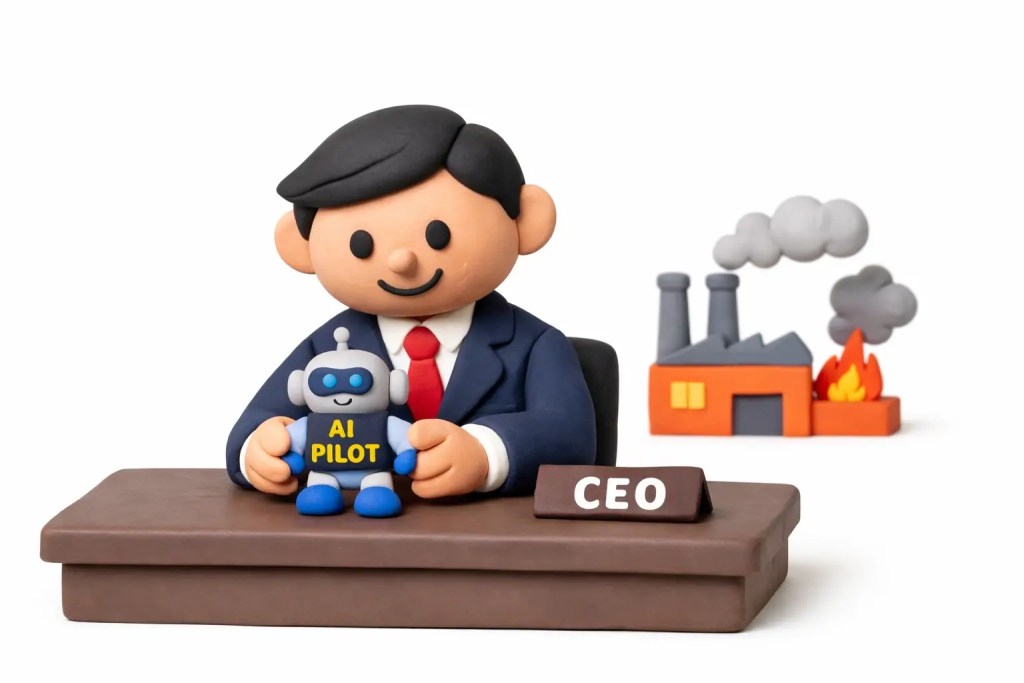
We’re Not Just Using AI. We’re Letting It Use Us.
New research from the Massachusetts Institute of Technology reveals something that should alarm every business leader: when people use AI tools like ChatGPT to write or solve problems, their brains show significantly less activity in networks responsible for cognition, attention, and creativity.
The most disturbing finding? After writing with AI assistance, most participants couldn’t recall what they had just “written.”
We’re not talking about a minor productivity trade-off. We’re entering what researchers now call a “stupidogenic society”—a world where technology doesn’t just make us lazy, it fundamentally erodes our ability to think, remember, and reason independently.
The Scale of the Problem
The data paints a troubling picture:
- 92% of university students now use AI regularly
- 20% have used AI to write all or part of an assignment without understanding the material
- Teachers report thousands of cases of students producing passable work while comprehending nothing
- Independent research shows more screen time in schools correlates with worse academic results
This isn’t just an education problem. It’s a workforce crisis waiting to happen.
How We Got Here: The Friction Problem
Technology companies have spent decades designing products to be frictionless—removing every obstacle, every moment of difficulty, every cognitive challenge that stands between us and instant gratification.
We optimized for convenience. We eliminated wait times. We made thinking optional.
And now we’re discovering that our brains need that friction. The mental challenges we designed away weren’t bugs—they were features. They’re what kept us sharp.
Stuart Jeffries, author of “A Short History of Stupidity,” puts it bluntly: “We think we’ve created tools for us, but everything we do—how we interact, how we communicate—has been shaped by technology. We are much more likely to be malleable to the machines, rather than the other way around.”
What This Means for Business Leaders
If you’re a CEO, board member, or executive leader, here’s what you need to understand:
Your competitive advantage isn’t your AI stack. It’s your people’s ability to think.
In a world where everyone has access to the same AI tools, differentiation comes from:
- Critical thinking that questions AI outputs rather than accepting them blindly
- Creative problem-solving that goes beyond pattern recognition
- Strategic reasoning that connects dots AI can’t see
- Contextual judgment that understands when and how to apply technology
These capabilities don’t develop automatically. They require practice, challenge, and yes—cognitive friction.
The Real Risk: From Convenience to Compliance
Here’s the trajectory we’re on:
We designed AI as an assistant. But without intentional guardrails, we’re creating something else entirely:
We’re moving from convenience to compliance, from assistants to groupthink, from efficiency to obedience.
When your workforce can’t recall what they’ve written, can’t think without AI scaffolding, and can’t differentiate between their ideas and machine-generated content, you don’t have an engaged, innovative team. You have a dependency problem.
And the most dangerous part? By the time you recognize you’ve lost your competitive edge, you may have lost your ability to recognize you’ve lost it.
The Outsider Advantage in the AI Era
There’s a counterintuitive opportunity here for leaders willing to see it.
While everyone else is racing to automate thinking, the leaders who preserve and develop human cognitive capacity will dominate. The companies that intentionally maintain “cognitive friction”—that require their people to think, struggle, and reason—will be the ones that:
- Spot opportunities AI misses
- Avoid groupthink disasters
- Innovate beyond pattern matching
- Build institutional knowledge that survives technological disruption
This is what I call the Outsider Advantage: while the majority follows the path of least resistance, those who swim against the current of frictionless convenience will develop capabilities that become increasingly rare and valuable.
What Leaders Can Do Now
1. Audit Your AI Deployment Don’t just ask “Are we using AI?” Ask “Is AI using us?” Look at how your teams actually interact with AI tools. Are they augmenting their thinking or replacing it?
2. Preserve Cognitive Challenges Build in moments that require genuine thinking:
- Require teams to explain AI outputs in their own words
- Create “no AI” brainstorming sessions
- Reward original thinking, not just efficient execution
- Test understanding, not just deliverables
3. Measure AI Challenge Rates as a Critical Thinking Metric Here’s a measurement that boards and leadership teams should be tracking: AI challenge rates across teams over time.
This metric answers a critical question: How often do your teams question, modify, or reject AI-generated outputs?
If your AI challenge rate is declining—meaning people are accepting AI suggestions without scrutiny—you’re watching your organization’s critical thinking capacity erode in real time. This is your early warning system for cognitive dependency.
Encourage your board to add this to their dashboards alongside traditional performance metrics. Track it by team, department, and function. Make it visible. Make it matter.
A healthy organization should see team members challenging AI outputs 40-60% of the time, demonstrating they’re thinking critically about recommendations rather than blindly accepting them.
4. Develop AI Literacy Your workforce needs to understand:
- When to use AI (and when not to)
- How to evaluate AI outputs critically
- The cognitive risks of over-reliance
- How to maintain their thinking skills while using powerful tools
5. Measure What Matters Beyond AI challenge rates, track:
- Quality of strategic thinking in leadership discussions
- Ability to recall and synthesize information without tools
- Creative problem-solving capabilities
- Critical evaluation of AI-generated content
- Time spent in deep work vs. shallow, AI-assisted tasks
6. Lead by Example If you’re a board member or executive, demonstrate that you value thinking over convenience. Ask hard questions. Require rigorous analysis. Show that cognitive effort is rewarded.
Challenge AI recommendations in board meetings. Model the behavior you want to see throughout the organization.
The Bottom Line
We stand at an inflection point. AI isn’t going away—nor should it. The question isn’t whether to adopt AI, but how to deploy AI in ways that amplify human intelligence rather than replace it.
The companies that figure this out won’t just survive the AI revolution. They’ll dominate it.
Because in a world where everyone has the same AI tools, the only sustainable competitive advantage is a workforce that can actually think.
The golden age of stupidity is optional. But only if we’re intentional about preventing it.
About the Author: Liat Ben-Zur is CEO of LBZ Advisory LLC and serves on the boards of Talkspace (NASDAQ: TALK), Compass Group PLC (LSE: CPG), and Splashtop. She advises Fortune 500 companies and tech startups on AI strategy and transformation, with prior executive leadership roles at Microsoft, Philips, and Qualcomm.
Related Articles:
The Innovation Paradox: Why Organizations Resist the Future They Say They Want
Forged in the Margins: Why the AI Era Belongs to Leaders with Scar Tissue – LBZ Advisory
The Chief AI Officer Delusion: Why Your New Executive Hire Will Fail