A week ago, I argued that “ChatGPT for Health” matters less as a chatbot and more as a new influence layer: intent formation, trust accumulation, and decision shaping before anyone touches a clinical workflow.
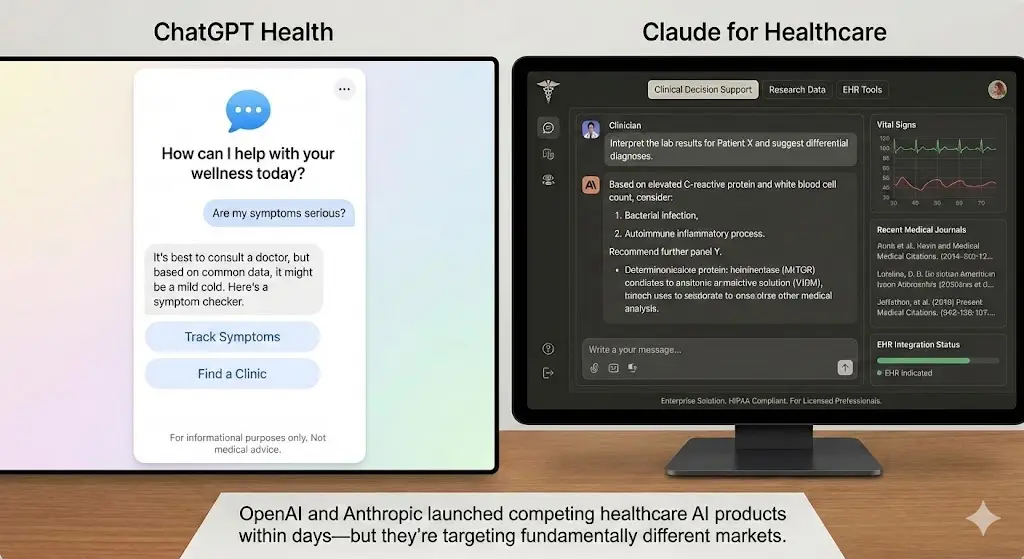
Five days after OpenAI launched ChatGPT Health, Anthropic fired back with Claude for Healthcare. The tech press framed it as a race between two AI giants scrambling for healthcare’s $4.5 trillion market. Both announced consumer health integrations. Both promised HIPAA-ready enterprise platforms. Both positioned themselves as the intelligent layer between patients and providers.
The actual story is more strategic, and much more interesting.
These aren’t competing products aimed at the same users disrupting the same workflows. They’re complementary bets on different parts of healthcare’s value chain, targeting distinct buyer personas with fundamentally different go-to-market strategies. Understanding the differences reveals which healthcare companies face genuine competitive threats versus which are watching a fight that doesn’t affect them.
The thesis: OpenAI is capturing consumer health intent and clinical workflow automation through horizontal scale and simplicity. Anthropic is building vertical depth for complex clinical reasoning and scientific workflows where accuracy matters more than speed.
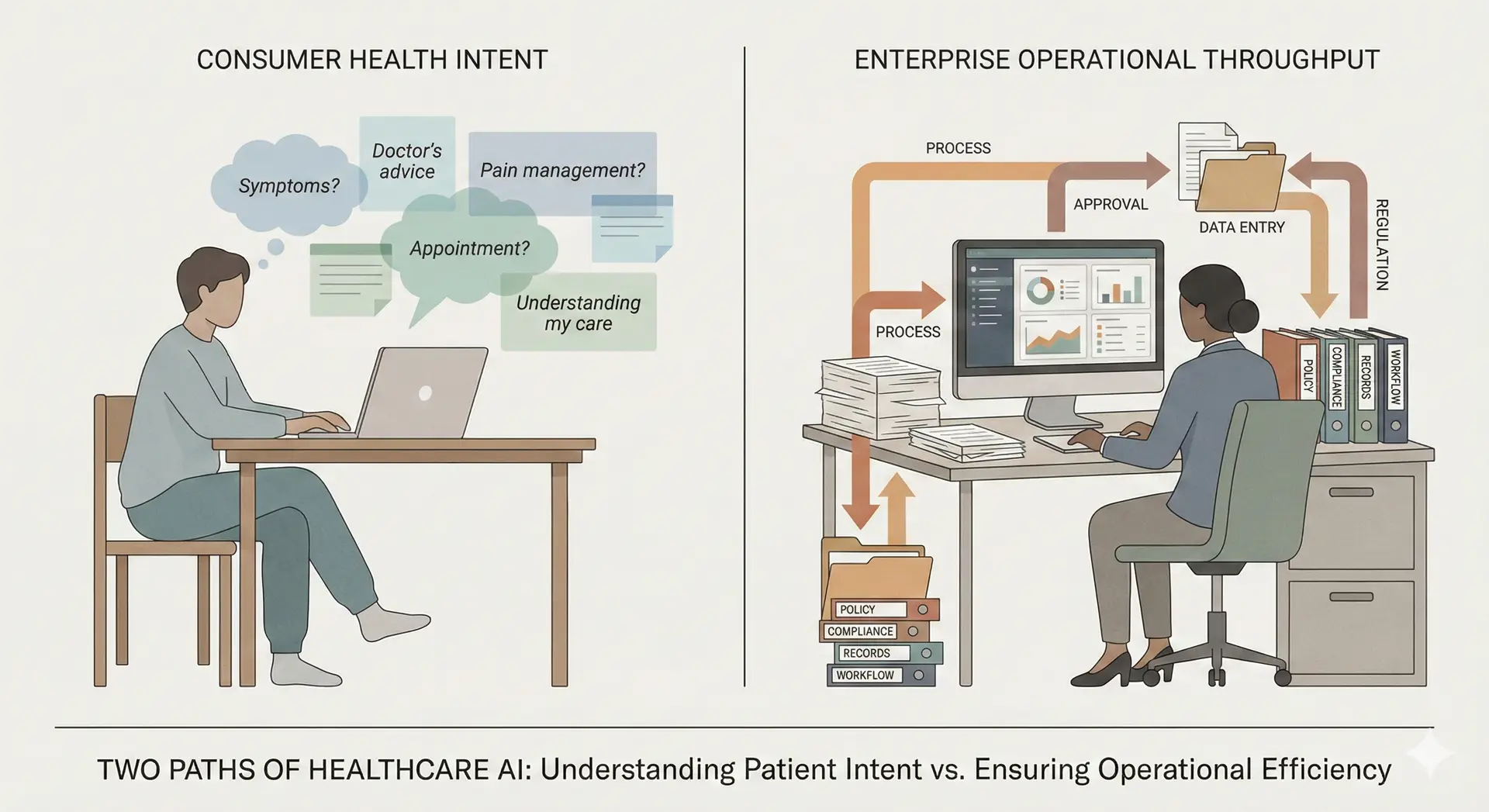
In other words, OpenAI is fighting to own the front door of healthcare cognition at population scale; Anthropic is fighting to own the middle-office plumbing where coverage, coding, records, and operational throughput decide what actually happens.
Both will succeed but in different segments, at different price points, serving different customers.
The strategic question is: “Which AI wins which parts of healthcare, and what does that mean for your organization’s positioning?”
The Surface-Level Similarities That Hide Strategic Divergence
Both announcements checked the same boxes:
Consumer health integrations
- Apple Health, Android Health Connect
- Lab results and medical records (via different aggregators)
- Wellness app connections (Function, MyFitnessPal, others)
- “Not a substitute for medical advice” disclaimers
Enterprise healthcare capabilities
- HIPAA-ready infrastructure with Business Associate Agreements
- Integration with clinical databases and medical literature
- Support for prior authorization, documentation, care coordination
- Encrypted data handling, no model training on health data
Life sciences support
- Clinical trial infrastructure
- Regulatory documentation
- Research workflows
- Scientific database access
Surface reading: These are identical products competing for the same customers.
Strategic reading: They’re staking claims to different territory using the same vocabulary.
The Actual Differences: Who They’re Built For
ChatGPT Health: The Consumer Front Door
OpenAI’s announcement emphasized consumer reach: “Over 230 million people globally ask health and wellness related questions on ChatGPT every week.” That’s the opening line. Not clinical accuracy. Not enterprise deployment. Consumer volume at scale.
OpenAI’s consumer move is explicitly about helping users understand health information, connect apps/records, and get personalized guidance in a dedicated “Health” space inside ChatGPT.
Primary target: Individual consumers navigating health information
Secondary target: Healthcare enterprises wanting horizontal AI across clinical, research, and administrative workflows
Tertiary target: Developers building consumer health applications
ChatGPT Health is a dedicated space within ChatGPT specifically for health conversations. It’s compartmentalized; health chats stay separate from regular ChatGPT usage. You access it from the sidebar, and it keeps health memories, files, and apps isolated.
The product design reveals intent: OpenAI wants to capture the patient-side health intent layer for hundreds of millions of people who already use ChatGPT for everything else. Health is the vertical integration of an existing consumer relationship, not a new product launching from zero. That matters because it shifts demand formation. Patients show up with pre-baked hypotheses, preferred options, and a baseline of “what the AI said.” That is exactly the asymmetric leverage I described: influence without delivery cost.
The wedge: You’re already using ChatGPT daily. Now give it access to your health data too, and get personalized health guidance without leaving the interface you trust.
ChatGPT for Healthcare (the enterprise product) follows the same pattern: horizontal deployment across clinical, research, and administrative workflows with minimal customization. Templates for discharge summaries. Evidence synthesis from PubMed. Integration with SharePoint and Outlook. Role-based access control. It’s a HIPAA-oriented workspace for clinicians, admins, and researchers, designed to reduce admin work and produce patient-ready outputs.
It’s designed for broad adoption across diverse use cases rather than deep specialization in specific clinical domains.
Claude for Healthcare: The Enterprise Precision Layer
Anthropic’s announcement led differently: “Advanced healthcare and life sciences capabilities enable organizations to deploy vertical-specific AI agents tailored to critical industry use cases.”
Anthropic is positioning Claude as “the system that can pull the right policy, check the record, draft the packet, and move the workflow,” especially in prior auth, claims, care coordination, chart review, and research/life sciences
Primary target: Healthcare enterprises and life sciences companies needing specialized reasoning
Secondary target: Developers building clinical-grade applications requiring accuracy and citations
Tertiary target: Consumers (as a defensive move, not the core strategy)
Claude for Healthcare emphasizes connectors to specific clinical and scientific systems: CMS Coverage Database, ICD-10, PubMed, Medidata (clinical trial management), and custom integrations via Model Context Protocol (MCP).
Where ChatGPT Health offers a compartmentalized consumer experience, Claude offers personal health integrations as table stakes to compete on parity—but that’s not where Anthropic is placing its strategic bet.
The Microsoft Foundry partnership announcement clarifies this: “Claude’s advanced healthcare and life sciences capabilities enable organizations to deploy vertical-specific AI agents tailored to critical industry use cases. These agents combine advanced model capabilities optimized for healthcare and scientific reasoning, enterprise-grade deployment paths aligned to industry requirements, and domain-specific connectors.”
The wedge: You need AI that understands complex clinical reasoning, integrates with healthcare-specific systems, and provides reproducible, auditable results with citations you can verify. Rather than trying to serve 230 million consumers, we’re trying to serve enterprises where clinical accuracy is non-negotiable.
So yes, both are “healthcare AI.” But they are disrupting different choke points.
The Model Capability Gap That Actually Matters
Both companies claim superior healthcare performance. OpenAI touts GPT-5 models “evaluated through physician-led testing.” Anthropic highlights Claude Opus 4.5’s “major forward step” on medical benchmarks.
Neither matters to consumers. For someone trying to understand their cholesterol results or prepare questions for a doctor’s appointment, both models are excellent. The capability gap is irrelevant at consumer use cases.
The gap emerges in complex clinical reasoning scenarios:
- Multi-step diagnostic reasoning requiring synthesis across specialties
- Clinical trial protocol generation with regulatory compliance requirements
- Prior authorization documentation requiring precise citation of coverage policies
- Genomic interpretation requiring integration of variant data with clinical phenotypes
- Drug-drug interaction analysis in patients with complex medication regimens
Anthropic’s focus on “agentic workflows” and “multi-step reasoning” suggests they’re optimizing for scenarios where a single query requires the AI to:
- Understand a complex clinical question
- Search multiple databases for relevant information
- Synthesize findings across sources
- Apply clinical judgment to the specific patient context
- Provide evidence-backed recommendations with verifiable citations
- Complete follow-up actions (like drafting documentation or filing forms)
This is fundamentally different from consumer health guidance, where questions are simpler: “What does this lab result mean?” or “Should I be worried about this symptom?”
OpenAI bet on horizontal breadth. Build one model that handles 80% of health use cases well enough across millions of users.
Anthropic bet on vertical depth. Build specialized capabilities for the 20% of use cases where clinical reasoning complexity justifies premium pricing and requires provable accuracy.
Both are correct—for their chosen segments.
The Enterprise Sales Motion Reveals Everything
OpenAI’s Go-To-Market: Bottoms-Up Consumer Adoption → Enterprise Upsell
OpenAI’s strategy:
- 300 million people already use ChatGPT. They’ve experienced the interface, trust the brand, and have formed habits.
- Launch ChatGPT Health as a consumer feature with personal health integrations.
- Consumers arrive at doctors’ offices having consulted ChatGPT about symptoms, treatments, medications.
- Clinicians experience AI-educated patients and realize they need institutional AI tools to keep pace.
- Hospital IT teams face grassroots demand: “Our clinicians are already using ChatGPT, we need to make it compliant and give them the enterprise version.”
- ChatGPT for Healthcare becomes the path of least resistance for organizations that want to govern AI adoption rather than fight it.
Early adopters of ChatGPT for Healthcare—HCA, Cedars-Sinai, Boston Children’s, Memorial Sloan Kettering—aren’t buying because Claude doesn’t exist. They’re buying because their clinicians are already using ChatGPT and they need to bring it inside the security perimeter with proper governance.
John Brownstein from Boston Children’s explicitly said this: “Our early work with a custom OpenAI-powered solution allowed us to move quickly, prove value in a secure environment, and establish strong governance foundations.”
Translation: We were already using it. We needed the compliant version so we could scale safely.
This is product-led growth applied to healthcare enterprise sales. Consumer adoption creates pull-through demand for enterprise licensing. The IT buyer isn’t making a cold evaluation between competing products—they’re responding to existing usage patterns among clinical staff.
Anthropic’s Go-To-Market: Top-Down Enterprise Sale with Clinical Validation
Anthropic’s strategy is fundamentally different:
- Partner with Microsoft Foundry to access enterprise healthcare customers through existing Azure relationships.
- Emphasize clinical-grade accuracy and specialized reasoning as differentiation.
- Target organizations with complex use cases where ChatGPT’s horizontal approach isn’t sufficient.
- Build domain-specific connectors that integrate with healthcare IT infrastructure (EHRs, clinical trial systems, regulatory databases).
- Position as the “responsible AI choice” for mission-critical clinical decisions.
- Launch consumer health features defensively to prevent OpenAI from owning the entire healthcare narrative.
The Microsoft Foundry partnership is revealing. Microsoft has deep enterprise healthcare relationships through Azure, Dynamics, and Teams. They already sell into hospital IT departments and have existing contracts.
Unlike OpenAI, Anthropic isn’t trying to build grassroots consumer adoption and convert it to enterprise sales. They’re entering through the CIO’s office with a story about clinical rigor, regulatory compliance, and integration with existing healthcare IT systems.
Eric Kauderer-Abrams (Anthropic’s head of life sciences, hired six months ago from computational biology startups) said: “A big piece of the challenge of using AI in healthcare is there’s basically no room for error. The cost of hallucinations, for example, or even the cost of non-reproducible analyses is very high.”
This is an enterprise buyer reassurance message aimed at CIOs and Chief Medical Officers who worry about liability exposure.
The Payer and Provider Implications Are Asymmetric
For Payers: Both AI Platforms Are Threats—But Different Threats
ChatGPT Health threatens demand management.
When 230 million consumers use ChatGPT for health guidance, they’re forming health literacy and expectations outside the payer’s control. Patients arrive at care encounters already educated about conditions, treatments, and alternatives. They question medical necessity denials. They understand prior authorization requirements and challenge them.
This shifts power from payers (who historically controlled information asymmetry) to consumers (who now have AI advisors). Smart payers respond by building their own AI-powered utilization management that competes with ChatGPT Health for patient trust—essentially creating “friendly AI” that helps members navigate care while optimizing within the payer’s cost structure.
UnitedHealth and Cigna will likely build (or acquire) their own consumer health AI that routes members to cost-effective care while maintaining the appearance of patient advocacy. The competitive threat is that OpenAI captures the patient relationship layer that payers need to retain pricing power.
Claude for Healthcare threatens operational efficiency.
When providers use AI to streamline prior authorization documentation, generate appeals with evidence-backed arguments, and synthesize medical literature supporting coverage decisions—suddenly the administrative burden shifts back to payers.
Right now, payers benefit from friction. Prior auth takes hours of physician time, appeals are complex, and many claims are abandoned because providers can’t afford the documentation burden. AI that automates the provider side of utilization management creates symmetric information where both sides have AI-powered argumentation.
This forces payers to compete on actual clinical appropriateness rather than administrative burden. That’s bad for margins. That’s why payers will need their own enterprise AI—not for consumer engagement but for defensive utilization management.
For Providers: The Choice Depends on Business Model and Use Case
Specialized care with complex reasoning: Claude for Healthcare
If you’re Memorial Sloan Kettering managing cancer genomics or Fred Hutch coordinating bone marrow transplants, you need vertical AI depth more than horizontal consumer reach. Your competitive advantage is clinical expertise in rare diseases with complex treatment protocols.
Claude’s emphasis on multi-step agentic reasoning, integration with scientific databases (PubMed, Medidata, specialized life sciences platforms), and reproducible results with citations aligns with high-acuity specialized care.
You choose Claude when:
- Clinical accuracy and explainability are mandatory
- You’re managing rare diseases with limited published literature
- You need integration with specialized clinical systems (genomics labs, clinical trial platforms, regulatory databases)
- Your physicians need AI that supports complex diagnostic reasoning, not just documentation
- Your use cases require provenance tracking and auditable decision support
Primary care and consumer-driven volume: ChatGPT Health
If you’re a primary care network managing chronic disease, urgent care centers handling routine complaints, or telehealth platforms serving high-volume consumer inquiries, you need horizontal scale more than vertical depth.
Your patients are already using ChatGPT Health for symptom checking and health education. They arrive with expectations set by consumer AI. Your operational challenge is handling volume efficiently, not solving rare diagnostic puzzles.
ChatGPT for Healthcare’s templates for discharge summaries, patient instructions, and administrative documentation support high-throughput workflows where standardization creates efficiency.
You choose ChatGPT when:
- Volume efficiency matters more than diagnostic complexity
- Your patients are already ChatGPT users expecting consistent experiences
- You need broad AI deployment across clinical, admin, and research functions without deep customization
- Your use cases are well-served by general medical knowledge rather than specialized scientific databases
- Your IT team wants minimal integration complexity and fast deployment
Both, in reality
Large integrated delivery systems will adopt both. They’ll use ChatGPT for horizontal deployment across primary care, administrative workflows, and patient education. They’ll use Claude for specialized oncology protocols, clinical trial management, and complex diagnostic reasoning in academic medical centers.
The strategic question isn’t “ChatGPT vs Claude?” It’s “Which workflows get which AI, and how do we govern a multi-platform strategy?”
The Vertical Depth Paradox Revisited
Remember the framework from the ChatGPT Health analysis: vertical depth creates moats only when paired with operational capacity to deliver care. AI alone isn’t advantage.
Anthropic is betting that complex clinical reasoning is a larger market than most people realize.
Consider the use cases Anthropic emphasized:
- Prior authorization requiring synthesis of coverage policies, clinical guidelines, and patient-specific factors
- Clinical trial protocol generation requiring regulatory knowledge and scientific methodology
- Insurance appeals requiring medical literature synthesis and evidence-based argumentation
- Care coordination for complex patients requiring integration across specialties
- Genomic interpretation requiring variant databases, phenotype correlation, and outcome predictions
These are high-value, high-frequency workflows that happen thousands of times daily across health systems—and they’re currently manual, time-intensive, and error-prone.
If Claude can demonstrably outperform ChatGPT on these complex reasoning tasks with better accuracy, fewer hallucinations, and verifiable citations, that’s defensible differentiation worth premium pricing.
But only if Anthropic can prove it.
Right now, both companies claim superior healthcare performance. Neither has published head-to-head comparisons on realistic clinical workflows. Healthcare buyers will demand proof, and the company that demonstrates measurable accuracy advantages in complex reasoning tasks will capture enterprise market share.
The consumer health integrations are defensive positioning, not core strategy.
OpenAI launched ChatGPT Health to own the patient relationship layer and drive enterprise adoption through bottoms-up demand.
Anthropic launched consumer health integrations to prevent OpenAI from monopolizing the “AI for health” narrative. They’re playing defense at the consumer layer while focusing offensive energy on enterprise clinical workflows.
If Anthropic didn’t launch consumer features, the story would be “OpenAI captures healthcare, Anthropic falls behind.” By matching ChatGPT Health feature-for-feature, they neutralize that narrative while differentiating on enterprise capabilities.
Smart strategy. But it means consumer health is table stakes, not differentiation for Anthropic. The real competition is in enterprise clinical reasoning—and that battle is just beginning.
The Data Strategy Asymmetry
OpenAI: Voluntary Consumer Data Accumulation at Scale
OpenAI’s consumer strategy accumulates voluntary health data from hundreds of millions of users who opt to share medical records, lab results, and wellness app data.
Even though this data isn’t used for model training (OpenAI says this explicitly), it provides strategic intelligence about:
- What health questions people ask most frequently
- Where existing health information is confusing or inadequate
- Which symptoms trigger care-seeking behavior
- How patients navigate between self-care, telemedicine, urgent care, and emergency departments
- What educational gaps exist in consumer health literacy
This is demand-side intelligence that healthcare providers don’t have. Providers only see patients during episodes of care. OpenAI sees the entire pre-care journey—the symptoms people worry about at 2am, the questions they’re afraid to ask doctors, the information that drives care-seeking decisions.
That’s valuable even if they never train models on it. It informs product strategy, partnership priorities, and where to build next.
Anthropic: Enterprise Clinical Data Through Provider Partnerships
Anthropic’s strategy accumulates clinical workflow data through enterprise deployments.
When health systems use Claude for prior authorizations, clinical documentation, and care coordination, Anthropic sees:
- How clinicians structure reasoning about complex cases
- Which clinical guidelines providers reference most frequently
- Where documentation workflows create friction
- Which specialties have unmet AI needs
- How real-world clinical decisions differ from published protocols
This is supply-side intelligence that consumer AI doesn’t capture. It’s the tacit knowledge of clinical practice that only emerges through deep integration with provider workflows.
Both data strategies are valuable—for different purposes, targeting different segments.
What This Actually Means for Healthcare Companies
The dual-threat scenario is real: Consumer AI (ChatGPT Health) captures intent formation. Enterprise AI (both platforms) automates workflows that were previously manual.
If You’re a Payer
You face threats on both sides:
Consumer side: ChatGPT Health educates members about coverage policies, prior auth requirements, and appeals processes—reducing information asymmetry that payers historically exploited.
Provider side: Claude for Healthcare (and ChatGPT for Healthcare) automates documentation and appeals for providers, reducing the administrative friction that payers relied on to manage utilization.
Strategic response:
- Build (or acquire) your own consumer health AI that helps members while optimizing costs
- Deploy your own enterprise AI for utilization management that competes with provider AI
- Shift from administrative burden as a utilization management tool to clinical appropriateness criteria enforced by AI
- Accept that AI levels the playing field between payers and providers—your advantage comes from better data, not better friction
If You’re a Specialized Provider
Choose AI based on clinical complexity:
Choose Claude if:
- You manage rare diseases requiring specialized knowledge
- You conduct clinical trials requiring regulatory precision
- You handle complex diagnostic reasoning across specialties
- You need verifiable citations and reproducible results
- You have budget for premium AI capabilities targeting specific use cases
Choose ChatGPT if:
- You need horizontal deployment across diverse workflows
- Your clinical use cases are well-served by general medical knowledge
- Your patients are already ChatGPT users
- You want fast deployment with minimal customization
- You prioritize volume efficiency over niche accuracy
Choose both if:
- You’re a large integrated system with heterogeneous needs
- You can manage multi-platform governance and workflow routing
- You want best-of-breed AI for different use case categories
If You’re a Primary Care Network
ChatGPT is probably sufficient. Your patient population is already using it. Your clinical workflows are well-served by general medical knowledge. Your competitive advantage is access, cost, and patient experience—not rare disease expertise.
But watch for payer moves. If major health plans deploy their own consumer health AI that routes to preferred providers, you need to either integrate with it or compete against it.
If You’re a Life Sciences Company
Claude’s clinical trial connectors (Medidata integration) and regulatory documentation capabilities suggest Anthropic is serious about scientific workflows beyond clinical care.
If you’re running complex trials, need AI for protocol generation, or want support with regulatory submissions—Claude’s vertical specialization may justify premium pricing over ChatGPT’s horizontal capabilities.
But both platforms will compete here. OpenAI’s API already powers clinical documentation and trial coordination tools (Abridge, Ambience). The question is whether Anthropic’s specialized connectors and scientific reasoning create measurable advantages worth switching costs.
If You’re Building Healthcare AI Products
The platforms are becoming infrastructure. Just as you wouldn’t build your own large language model from scratch, you increasingly won’t build healthcare-specific AI from scratch—you’ll build on top of ChatGPT or Claude.
Key questions:
- Which platform’s API pricing and rate limits fit your economics?
- Which platform’s accuracy and hallucination rates meet your clinical safety requirements?
- Which platform’s connectors and integrations reduce your development burden?
- Which platform’s compliance posture (BAAs, audit trails, data residency) aligns with your customers’ requirements?
You’re not choosing an AI model. You’re choosing an AI infrastructure layer that determines your technical capabilities, go-to-market strategy, and economic model.
The Three-Year Forecast: Coexistence, Not Winner-Take-All
Five years from now, healthcare won’t have a single AI platform. It will have stratified adoption based on use case complexity, buyer sophistication, and price sensitivity.
Consumer health: ChatGPT dominates through distribution advantage and product-led growth. Anthropic maintains competitive parity to avoid losing mindshare but doesn’t win marketshare.
Primary care and generalist workflows: ChatGPT leads through horizontal scale, template libraries, and ease of deployment. Health systems choose it for broad adoption across clinical, admin, and research functions.
Specialized clinical reasoning: Claude captures market share in complex cases requiring multi-step reasoning, scientific database integration, and verifiable citations. Academic medical centers, cancer centers, and specialty hospitals pay premium pricing for vertical depth.
Life sciences and pharma: Split adoption. Large pharma with existing Microsoft relationships deploy Claude through Foundry. Biotech startups building consumer-facing products use ChatGPT API for economics and developer experience.
Payer utilization management: Custom AI built on OpenAI or Anthropic APIs, or acquired through HealthTech M&A. Payers won’t cede control of utilization management to third-party AI platforms—they’ll build proprietary systems with underlying LLM infrastructure from vendors.
The endgame isn’t “OpenAI wins” or “Anthropic wins.”
It’s both platforms coexist as infrastructure layers supporting different segments of healthcare’s $4.5T market. Developer tools (APIs) commoditize. Enterprise products differentiate on vertical depth, integration ecosystems, and compliance posture. Consumer products differentiate on distribution and trust.
The healthcare companies that win are those who:
- Understand which AI capabilities create genuine clinical or operational value
- Choose platforms strategically based on use case requirements, not brand hype
- Build AI governance frameworks that enable multi-platform strategies
- Focus organizational energy on execution moats (care delivery, relationships, outcomes) rather than fighting AI platforms on their home turf
The existential mistake is believing AI platforms are your competitors. They’re infrastructure—increasingly commoditized infrastructure. Your competitors are other healthcare companies who deploy AI infrastructure more effectively to deliver better patient experiences, clinical outcomes, and operational efficiency.
What Leaders Must Do Differently
Stop treating “AI strategy” as a single decision. You don’t have one AI strategy. You have multiple AI strategies for different use cases, buyer personas, and clinical workflows.
For consumer-facing health:
- Accept that patients arrive AI-educated through ChatGPT Health
- Build workflows assuming patients have already consulted AI
- Compete on care delivery quality and relationship continuity, not information asymmetry
- Consider offering your own consumer health AI (or partnering with existing platforms) rather than fighting consumer adoption
For enterprise clinical workflows:
- Map use cases by reasoning complexity, accuracy requirements, and integration needs
- Choose ChatGPT for horizontal deployment at scale; Claude for vertical specialization in complex reasoning
- Plan for multi-platform governance from day one rather than assuming single-vendor solution
- Measure AI effectiveness on operational outcomes (time savings, accuracy improvements, cost reduction) not just adoption metrics
For specialized clinical domains:
- Evaluate whether vertical AI depth creates defensible differentiation for your organization
- If you have genuine data advantages (rare diseases, longitudinal outcomes, multi-modal integration), consider building proprietary AI on top of foundation model APIs
- If you don’t have data advantages, focus energy on care delivery excellence and let commodity AI handle cognition
For AI vendor negotiations:
- Demand head-to-head accuracy comparisons on realistic clinical workflows, not toy benchmarks
- Require transparent pricing that accounts for API call volumes at scale, not just per-seat licensing
- Negotiate BAAs that provide genuine liability protection, not just compliance theater
- Insist on data residency, audit trails, and customer-managed encryption keys as table stakes
Most importantly: stop catastrophizing and start executing.
Healthcare AI isn’t winner-take-all displacement. It’s gradual workflow transformation where execution beats strategy. The organizations that deploy AI effectively across hundreds of workflows will outcompete those waiting for “the perfect AI platform” or “the right strategic moment.”
The perfect platform doesn’t exist. The companies that move will learn, iterate, and build advantages.
Neither ChatGPT Health nor Claude for Healthcare is disrupting healthcare delivery. They’re becoming the cognitive infrastructure layer that healthcare delivery depends on. The strategic questions now are which workflows you’ll optimize with which AI, and whether you can execute deployment faster than your competitors.
Liat Ben-Zur is CEO of LBZ Advisory and serves on the boards of Talkspace, Compass Group, and Splashtop. She helps healthcare, B2B SAAS, retail, hospitality, and industrial companies navigate strategy in an AI-native world—focused on execution, not hype.