The era of “Chatting with your data” is officially over.
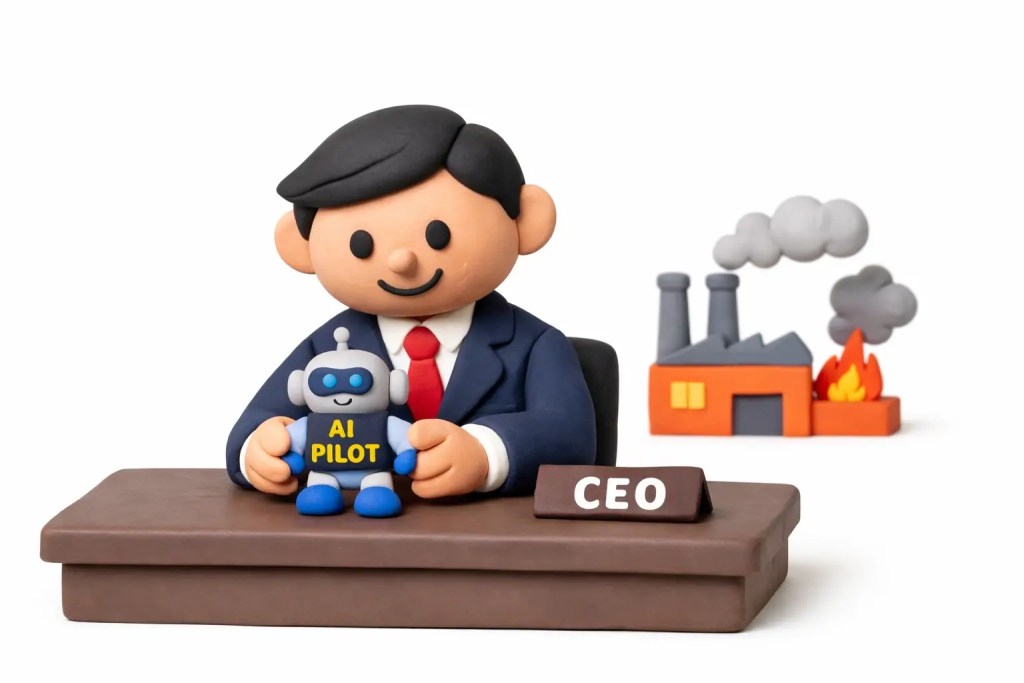
If your 2026 AI strategy still involves employees logging into a shiny new portal to “prompt” a chatbot, you are just adding another layer of friction to an already exhausted workforce. The goal of enterprise AI was never to give people a better co-pilot; it was to remove the need for a pilot in the first place for routine, high-volume operations.
We are entering the age of the Invisible Enterprise.
This shift is driven by a fundamental realization: The most valuable AI is the one you never see. It operates in the background, making decisions, moving data, and executing workflows while your team sleeps. We call these Ghost Workers. They don’t need a UI. They don’t need a dashboard. They just need context and a way to talk to your existing systems.
The UI Tax: Why Dashboards Are Failing
For the last decade, “Software is eating the world” meant “Software is giving everyone more tabs to open.”
Every dashboard represents a human bottleneck. Research indicates that as confidence scores in AI models rise, the necessity for a visual interface recedes. Traditional dashboards are becoming governance tools rather than operational ones.
In the old world, we built UIs because humans are visual and deterministic. In the new reality, agents are probabilistic and operate at a scale where human visual monitoring is impossible. If an agentic workflow is processing 5,000 supply chain adjustments a second, a dashboard is useless. You need an audit log and a kill switch, not a chart.

MCP: The TCP/IP of the Agentic Web
The technical backbone of this “no-interface” future is the Model Context Protocol (MCP).
Think of MCP as the universal “USB-C port” for intelligence. Until now, connecting an AI to your CRM, ERP, or internal database required custom integrations or fragile “screen scraping.” MCP standardizes how AI agents access data and tools. It allows an agent to reach into your tech stack, grab the context it needs, and perform an action without a human ever acting as the middleman.
The shift is structural:
- Old World: Use an API to pull data into a UI so a human can tell an AI what to do.
- New Reality: Use MCP to expose “Context Servers” directly to agents that execute in the background.
When your systems speak MCP, your AI agents don’t need to “log in” to Salesforce. They simply query the Salesforce MCP server, get the context, and update the record. The UI becomes an afterthought: a place you go only when something breaks or when you need to set a new high-level policy.
From SaaS Seats to Agentic Outcomes
This transition is triggering a massive repricing of enterprise software. The traditional “per-seat” license model is a relic of the era where humans did the work. If an agent is doing the work of 50 people via a background MCP connection, paying for 50 “seats” makes zero sense.
We are moving toward Outcome-Based Pricing.
You won’t pay for the software; you’ll pay for the result. This is why we are seeing an AI SaaS valuation collapse. Companies that rely on “human seats” are seeing their moats evaporate. The winners are those who build “invisible plumbing” that justifies its cost through P&L impact: reducing churn, optimizing logistics, or accelerating R&D cycles: without requiring a single human login.
Key Research: Industry data shows that by the end of 2026, 60% of enterprise AI interactions will occur via background agentic workflows rather than user-initiated chat prompts. The focus has shifted from “User Experience” (UX) to “Agent Experience” (AX).

Strategic Moves for CEOs: Build Context, Not Portals
If you are leading a company today, your priority isn’t buying more AI apps. It’s preparing your infrastructure for autonomous agents. Here is your tactical playbook:
- Stop Funding “Portals”: If a vendor pitches you a “single pane of glass” for your AI, walk away. You don’t need another window; you need a way to shut the windows. Focus your budget on backend integration and data cleanliness.
- Deploy “Context Servers”: Start converting your internal data silos into MCP-compliant Context Servers. This makes your data “legible” to AI agents. If an agent can’t “read” your business logic through a protocol like MCP, it’s useless.
- Define Governance Surfaces: Since you won’t be watching the work happen in real-time, you need a Board AI Scorecard to manage risk. Your “UI” should be a policy engine where you set the boundaries (spend limits, ethical constraints, data permissions) within which the Ghost Workers must stay.
- Audit Your “Seat” Spend: Look at your SaaS renewals. If a tool is primarily used for data entry or routine reporting, demand an agent-based pricing model. Do not pay for seats that will soon be occupied by background processes.
What to Avoid
- The “Copilot” Trap: Don’t get stuck in the mindset that AI must be a “helper” to a human. Many of your processes shouldn’t have a human in the loop at all.
- Custom UI Development: Building custom front-ends for AI is a waste of capital. By the time you ship the UI, the underlying model will likely have rendered the interaction model obsolete.
- Data Hoarding: Agents need “fresh” context. Static data lakes are where AI goes to die. Focus on streaming context via MCP.

Strategic FAQs
How do we maintain control if there is no dashboard to look at?
Control shifts from “operational monitoring” to “governance by policy.” In the old model, you controlled a process by watching a person do it. In the agentic model, you control a process by defining the “guardrails” in code. This is a higher level of control, not a lower one. You move from being a supervisor to being a legislator. Your “dashboard” becomes a set of alerts that only trigger when an agent hits a confidence threshold it can’t resolve or a spend limit you’ve pre-defined. Trust is built through transparency mechanisms: audit trails that explain the “why” behind an agent’s move: rather than watching the move happen in a UI.
Does this mean we are firing our entire middle management?
It means the job of middle management changes from “traffic controller” to “agent orchestrator.” Instead of spending 80% of their time moving data between systems and checking for errors, managers will spend their time optimizing the “prompts” and “policies” that govern the Ghost Workers. We are seeing a shift where a single manager can oversee a fleet of 1,000 agents. This isn’t just about headcount reduction; it’s about increasing the “velocity of intelligence” across the organization. The value of a human manager in 2026 is their ability to define intent, not their ability to manage a spreadsheet.
Is MCP actually ready for prime time in the enterprise?
MCP is where TCP/IP was in the early days of the internet. It is the emerging standard that solves the “last mile” problem of AI: how to let a model actually do something in a secure, standardized way. Large players like Anthropic and others are already throwing their weight behind it because they know that the “Chatbot” era is a temporary phase. Enterprises that adopt MCP early are essentially future-proofing their data. They are building a “pluggable” architecture where they can swap out the “brain” (the LLM) without having to rewrite all the “nerves” (the integrations).
The Synthesis: The Invisible Outlook
2026 is the year we stop “using” AI and start “deploying” it.
The dashboard was a security blanket for a world that didn’t yet trust the machine. As we move toward the Invisible Enterprise, the competitive advantage belongs to the CEOs who can let go of the “screen” and embrace the “protocol.”
Your strategy should be to build a system where the routine work happens so flawlessly in the background that your employees can finally focus on the high-leverage, creative, and strategic problems that AI still can’t touch.
Build your Context Servers. Hire your Ghost Workers. Kill the dashboard.
Need help navigating the shift from SaaS seats to agentic outcomes? LBZ Advisory works with Boards and CEOs to build the governance and infrastructure required for the age of invisible intelligence.