For decades, the corporate machine prioritized a specific type of leader: the linear climber. This person started in the “right” company, moved up on schedule, stayed in one functional identity, and accumulated status and technical fluency. We called it “high potential.” We built hiring rubrics around it. We designed promotion loops to reward it.
But the AI era is rewarding a different operating system.
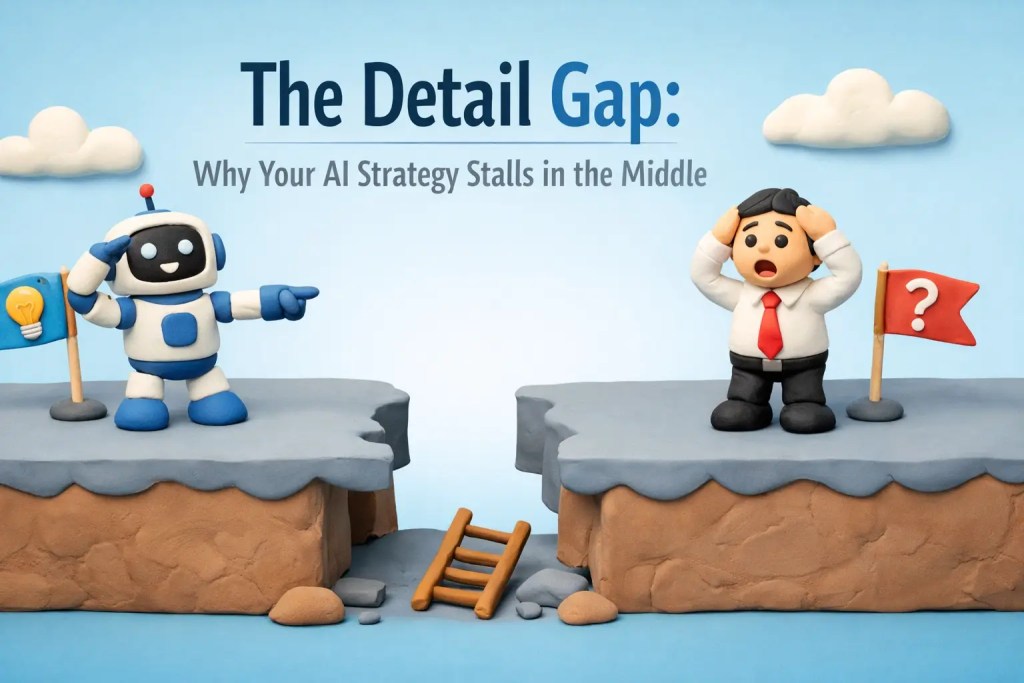
AI transformations are not blocked by model capability. They are blocked by organizational reality: messy handoffs, exception paths, political incentives, and the Translation Problem between output and decision. That environment favors leaders with non-linear paths, diverse backgrounds, and high resilience—people who have already rebuilt their identity more than once and can do it again without spiraling into identity threat.
It used to be that a resume with caregiving breaks, lateral moves, and industry pivots was read as instability. In the AI era, that history is rehearsal. You’ve practiced learning under constraints. You’ve navigated systems that weren’t built for you. You’ve developed context, judgment, and social sensing that AI can’t generate.
Now, the most underused assets in your labor market—the people who have had to learn, unlearn, and relearn their whole lives—are your most durable advantage.
The Skillset Flip: From Technical Fluency to Contextual Judgment
Technical fluency is becoming table stakes. When anyone can generate code, draft a marketing brief, or synthesize a legal memo using LLMs, speed stops being scarce. Judgment becomes scarce.
The bottleneck in most organizations isn’t the AI’s capability; it’s the Translation Problem. It’s the gap between a raw AI output and an accountable business decision that survives audit, edge cases, and the invisible enterprise of “how work really happens.” Bridging that gap requires leadership skills you don’t learn in a weekend certification:
- Judgment Under Ambiguity: Knowing when a confident answer is a hallucination, an overgeneralization, or a policy risk.
- Pattern Recognition Across Contexts: Connecting signals across functions, markets, and cycles—then deciding what actually matters.
- Exception-Path Thinking: Anticipating the 20% of cases where AI fails and humans get blamed.
- Incentive Awareness: Seeing where adoption will stall because people are rationally protecting status, headcount, or identity.

Traditional hiring over-valued “depth in one lane.” The New Reality demands breadth with scar tissue. This is where unconventional leaders excel. People who have navigated re-entries, pivots, layoffs, relocations, and reinvention have built resilience and contextual synthesis that linear careers rarely force you to develop. They didn’t wait for AI to make work unstable. They’ve been operating in instability for years.
The Resilience of the Nonlinear Path
Nonlinear careers produce leaders who can move through disruption without denial. That is now a core executive capability.
The traits we used to penalize—switching industries, lateral moves, gaps, outsider status, being “sideways”—map directly to what AI transformations demand: sensemaking across ambiguity, not compliance inside one function.
When a career path is a straight line, perspective tends to narrow. You become an expert in the rules as they exist today. AI changes those rules faster than your org can rewrite job ladders. That creates identity threat: people protect the processes that made them valuable, even when those processes are the problem. Adoption stalls, not because the model is wrong, but because the human system is defending itself.
Unconventional leaders have already practiced rebuilding identity. They tolerate the blank page. They can say, “This workflow is obsolete,” without hearing it as “I am obsolete.” That is the Bias Advantage: not “bias” in the algorithmic sense (which is a security vulnerability), but lived perspective that helps you see what the machine misses and what the organization is afraid to admit.
Operating Goal: Re-evaluate leadership readiness by Adaptability Quotient (AQ), not by who has the most current AI certifications.
The “Only One” in the Room: A Personal Reality Check
I’ve spent a long time in rooms where I was the “only.” The only woman. The only one without the “right” pedigree. The only one coming at the problem sideways because my background didn’t match the groupthink.
For years, that felt like a liability. I felt I had to over-prove technical fluency just to be heard. I worried my unconventional path—moving across industries and roles—would be read as a lack of focus.
AI changes how that story lands.
AI programs fail at the seams: between product and legal, between security and sales, between “the demo” and the exception paths that hit customers. Being “the only” forces you to develop the muscles that matter in those seams: translation, pattern recognition, and the ability to hold competing incentives in your head without simplifying them away.
The very things that made me an outsider are the things that make me effective at AI Strategy & Business Consulting. Being underestimated gives you room to observe what the credentialed experts miss. Navigating different worlds builds the ability to synthesize across them.
If your background feels “wrong” for this moment, take a second look. AI is amplifying sameness. Your job is to prevent it.

Practical Moves: Leveraging Unconventional Leaders
To move beyond surface-level AI adoption, you must change how you deploy leadership—not just tools. Here is how to stop sidelining your most effective operators:
- Redefine “High Potential” for AI: Promote the rebuilders. Track employees who have switched functions, restarted after interruptions, or scaled in messy environments. They have the mental models to integrate AI into existing workflows without breaking accountability.
- Put Nonlinear Leaders in the Seam Roles: Assign them to the handoffs where AI implementations die: product ↔ legal, data ↔ compliance, security ↔ engineering, sales ↔ delivery. Their advantage is cross-language translation.
- Run an Exception-Path Audit Before You Automate: AI is strong in the 80% path. Your unconventional leaders—often the ones who’ve been forced to operate without perfect process—are best at finding the brittle 20% that turns into customer escalations.
- Build “Human-in-the-Loop” Governance That Matches Reality: Don’t put the most junior person on review. Put the person with the most contextual breadth on review. That’s how you protect long-term ROI and avoid expensive rework.
- Institutionalize Cognitive Diversity, Not “Culture Fit”: Stop hiring for sameness. Hire for culture add. AI will produce homogenized output by default. You need leadership that pushes against that drift.
What to Avoid
- Avoid over-indexing on youth for AI roles. While digital natives are comfortable with the tools, they often lack the business context to know if the tool is providing a good answer or just a fast one.
- Avoid penalizing “gaps” on resumes. A three-year gap for caregiving is three years of intense project management, crisis resolution, and multitasking. That is a feature, not a bug.
- Avoid treating AI as a replacement for experience. AI is a multiplier. If you multiply a zero (someone with no context), you still get zero. If you multiply a veteran’s experience with AI, you get an unstoppable lead.
FAQ: Strategic Deep Dives
How do we measure the value of “judgment” when AI is doing the heavy lifting?
Measurement must shift from output volume to “quality of synthesis.” In the Old World, we measured how many reports a person could produce. In the New Reality, we measure how many “wrong” directions were avoided because a human with context intervened. You measure the cost of avoided errors. This requires a shift in how you prove AI productivity ROI. Use “Red Teaming” exercises where your most experienced talent tries to find flaws in AI-driven strategies. The value is found in the “catch.”
Why is “outsider status” suddenly a leadership strength?
Insider status creates “Incentive Misalignment.” If you have spent 20 years perfecting a specific manual process, you are incentivized to protect it, even if it’s obsolete. An outsider has no such allegiance. They can see the “Invisible Enterprise”: the hidden inefficiencies and legacy debts: that insiders have grown blind to. AI requires a level of organizational honesty that insiders often struggle to provide. Outsiders are the only ones who can call out the “emperor’s new clothes” when an AI implementation is failing.
Is the “Bias Advantage” really enough to compete with big tech?
Big tech has the compute, but you have the context. The “Bias Advantage” is about the specific, narrow, and deep interventions that a general-purpose AI cannot replicate. By leveraging talent that thinks differently, you create a “jagged frontier” of capability that is impossible for a competitor to copy. Your defense isn’t the software; it’s the human judgment that directs the software.
Synthesis: The Path Forward
The coming year will be defined by a massive reshuffling of power. Those who continue to chase the “mythical high potential” profile: the linear, technical-only worker: will find themselves with a workforce that is easily replaced by a $20/month subscription.
The winners will be the leaders who recognize that the “underused” talent they’ve been ignoring is actually their most sophisticated defense system. The women who have navigated interruptions, the outsiders who see the world sideways, and the veterans who know how the engine actually works are the ones who will lead us through this transition.
This is the core of my upcoming book, The Bias Advantage: How Unconventional Leaders Gain Power in an AI-Driven World, coming out later this year. We are moving toward a world where your “wrong” background is your greatest asset.
It’s time to stop apologizing for your nonlinear path and start leading with it.