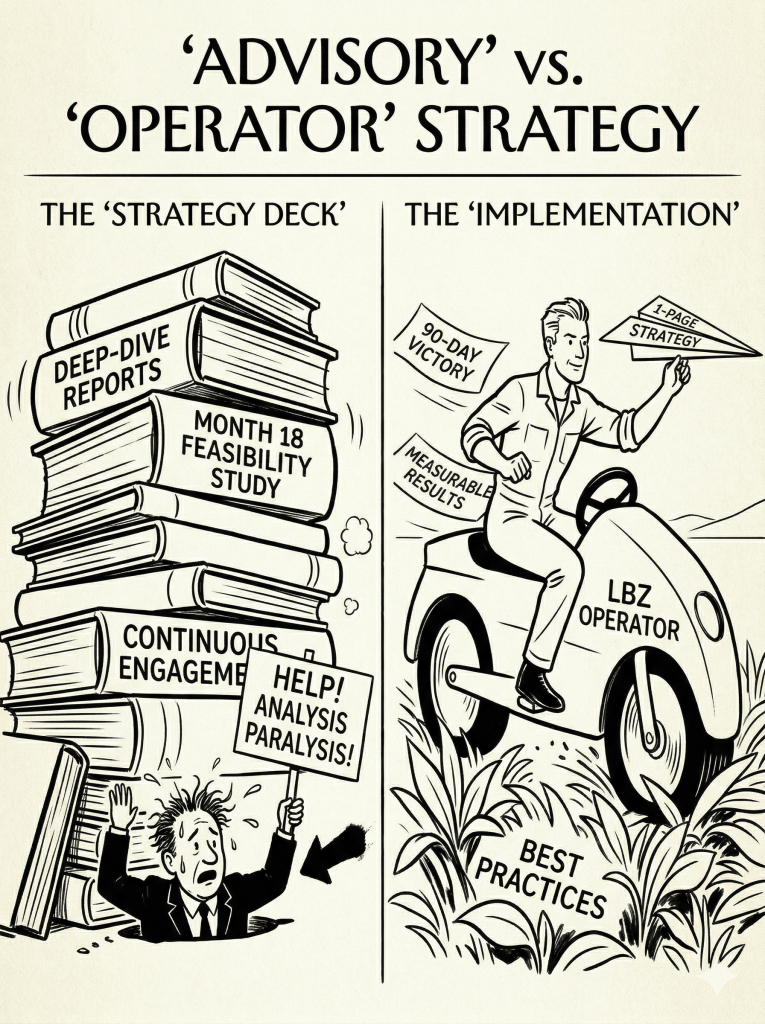
When your company needs an AI strategy, you’ll likely consider the big names: McKinsey & Company, Boston Consulting Group (BCG), and Bain & Company. They’re household names with incredible prestige and global reach.
But there’s a critical difference between strategy that looks good on a deck and strategy you can actually execute.
McKinsey, BCG, and Bain: What They Do Well
McKinsey is known for:
- Problem framing at the executive level
- Extensive market research and benchmarking
- Deep relationships with boards and C-suites
- Global reach across industries and geographies
BCG brings:
- Sophisticated analytical frameworks
- Thought leadership on emerging technologies
- Brand prestige that influences board decisions
- End-to-end transformation consulting
Bain focuses on:
- Business strategy with financial rigor
- Detailed implementation planning
- Long-term engagement relationships
- Industry-specific expertise
Where LBZ Advisory Is Different (And Why It Matters)
1. We Don’t Expand the Problem. We Reduce It.
McKinsey, BCG, Bain: Start broad. Map the landscape. Explore multiple scenarios. Build alignment across a wide set of stakeholders.
LBZ Advisory: Start by cutting.
Most companies I work with aren’t short on AI ideas. They’re overloaded with them.
There are too many use cases, too many vendors, too many internal initiatives competing for attention. Everything feels important, so nothing moves.
The first move is narrowing. Not exploring.
We identify the few areas where AI can realistically move the business in the next 6–12 months, given your current data, teams, and decision-making speed. Then we cut everything else.
That’s where momentum starts. Not with more options, but with fewer.
2. We Design for the Company You Actually Are
McKinsey, BCG, Bain: Strategy is often shaped by what “leading companies” are doing or what the future state should look like.
LBZ Advisory: Strategy starts with your constraints.
Every company thinks it needs a better AI strategy. Most need a strategy that matches how they actually operate.
Data isn’t where people think it is. Ownership is unclear. Decisions take longer than anyone admits. Some teams are supportive in meetings and resistant afterward.
These aren’t edge cases. This is the environment the strategy has to survive in.
So we build around it.
We look at how decisions really get made, where things slow down, and what would block this from moving forward. That becomes the starting point, not something to “fix later.”
3. We Force the Decisions That Actually Matter
McKinsey, BCG, Bain: Build alignment through analysis, workshops, and multiple options.
LBZ Advisory: Push for decisions early, before the organization has a chance to drift.
AI strategy tends to stall in very specific places.
No one owns the outcome.
Success metrics are vague.
Data access turns into a negotiation.
Priorities shift once execution starts.
All of this is predictable.
The work is getting clear on these points early, while there’s still room to make decisions.
Who owns this?
What does success look like in business terms?
What data is required, and who controls it?
When those answers are explicit, things move. When they’re not, progress slows down without anyone quite naming why.
I’ve sat in the meetings where teams spend weeks debating use cases while nothing ships. I’ve also been the one accountable when those decisions didn’t land.
That changes how I approach this work.
4. You Don’t Need a Bigger Program. You Need a Clear One.
McKinsey, BCG, Bain: Often lead to larger, multi-phase programs. Strategy expands into transformation.
LBZ Advisory: Deliberately constrained.
Most organizations I work with are already running multiple AI efforts at the same time.
Different teams. Different tools. Different timelines.
On paper, it looks like progress. In practice, it spreads effort thin and makes it harder to get anything into production.
Clarity comes from focusing on a small number of priorities tied to real outcomes. Revenue, cost, clinical impact. Something the business actually feels.
That focus creates traction. It also makes tradeoffs visible, which is where real progress starts.
5. You’re Not Paying for Volume. You’re Paying for Judgment.
This is where the difference really shows up.
Large firms are structured around teams, process, and scale. That drives cost up and often stretches timelines out.
LBZ Advisory is different by design. This work comes down to judgment.
What to prioritize. What to cut. What will actually hold up once the organization starts pushing back.
That’s hard to outsource to a large team or a process.
In this model, you’re working directly with someone who has operated at scale, made these calls, and seen where they break. There’s no layering, no handoffs, no separate team translating strategy into execution.
The cost structure reflects that. You’re not funding a large engagement to explore every path. You’re investing in clear decisions on where to focus and how to move.
That’s usually where the real leverage is.
The Real Trade-off
Big Consulting Firms are best for:
- Organizations that need board-level credibility and brand safety
- Multi-year transformation programs at massive scale
- Companies that want to outsource the entire transformation
- Industries where regulation requires certain advisory rigor
LBZ Advisory is best for:
- Organizations ready to move from strategy to execution fast
- Companies that want operator-level thinking, not advisory frameworks
- Teams that need clarity before complexity
- Leaders who want accountability and measurable outcomes
The Bottom Line
McKinsey, BCG, and Bain are incredible at what they do: strategic thinking, industry expertise, and building credibility with boards.
But if you want strategy that’s grounded in reality, delivered at speed, and designed for your team to execute independently—without ongoing consulting dependency—LBZ Advisory is the better choice.
The question isn’t “which firm is bigger or more prestigious.” It’s “do you want a strategy that looks great in a presentation, or one you can actually execute?”
Ready to move from strategy to execution? Book a Consultation