

In Murdock, Nebraska, a village of roughly 275 people, plans for two potential data centers brought farmers, labor leaders, and environmentalists into the same firehouse. They were trying to understand what would happen to farmland, water, electricity bills, and the town’s future. ABC News reported that the plans were later paused, but the questions have traveled far beyond Nebraska.
The country should build this infrastructure. A data center can support scientific research, new companies, advanced manufacturing, and more reliable energy systems; in Ohio, The Guardian reported on a proposed facility promising 35,000 construction jobs and 2,500 operating jobs. The same project has raised questions about power, water, pollution, and the site’s history as a former uranium-enrichment facility. American ambition and local scrutiny belong in the same conversation.
Editorial note: I first made the case for an American AI lead that includes working families and local communities in Fox News Opinion. This essay develops the infrastructure question inside that argument: what must the country offer the communities that host and power the AI economy?
The case for building
The United States should build. It needs the physical capacity to train models, run them securely, and put them to work in laboratories, hospitals, factories, utilities, universities, and small companies. Data centers are part of that productive base, alongside chips, energy, networks, talent, and data.
The promise is clearest inside a real institution. A hospital can test diagnostic systems against large datasets; a manufacturer can model materials and detect equipment failures; a small company can build an AI service without owning a supercomputer. In the technology organizations where I have worked, the most exciting moments came when a capability reached people who could attempt something previously too slow, expensive, or difficult. Compute gives American institutions more chances to test an idea instead of merely reading about one.
Compute is becoming scientific infrastructure
The Department of Energy’s Genesis Mission shows what the buildout can support. It connects national laboratories, supercomputers, artificial intelligence systems, instruments, and scientific datasets, with a stated goal of doubling the productivity and impact of American research and innovation within a decade. More compute lets researchers run simulations, compare designs, and connect results to physical experiments across fusion, materials, medicine, manufacturing, energy, and the electric grid. (Genesis Mission; U.S. Department of Energy)
The same capacity reaches commercial life. The Department of Energy reports substantial employment, labor income, and economic activity from Virginia’s data-center industry, though those figures describe one region rather than a promise every host community can claim. Reliable domestic compute lets hospitals, manufacturers, universities, professional-services firms, and startups build close to the data and customers they understand. (DOE Data Center Resource Hub)
Leadership is more than a security advantage
American AI leadership would give the United States influence over the systems and standards other countries adopt. Capacity in chips, models, data centers, and deployment gives the country a stronger voice in interoperability, safety testing, data practices, procurement, and cross-border rules. Those decisions will shape medicine, education, communications, public administration, and work, not just defense.
The United States AI Action Plan presents infrastructure, innovation, and international influence as one contest. That is a government policy position, not settled fact, but the choice is real: build enough secure capacity to shape the systems and standards others use, or depend more heavily on systems and rules shaped elsewhere. Domestic capacity can also sustain research during supply disruptions, improve critical-infrastructure planning, support government systems, and strengthen energy, networking, and manufacturing capabilities. Public support will last longer when communities can see what the infrastructure returns.
Who pays for the buildout?
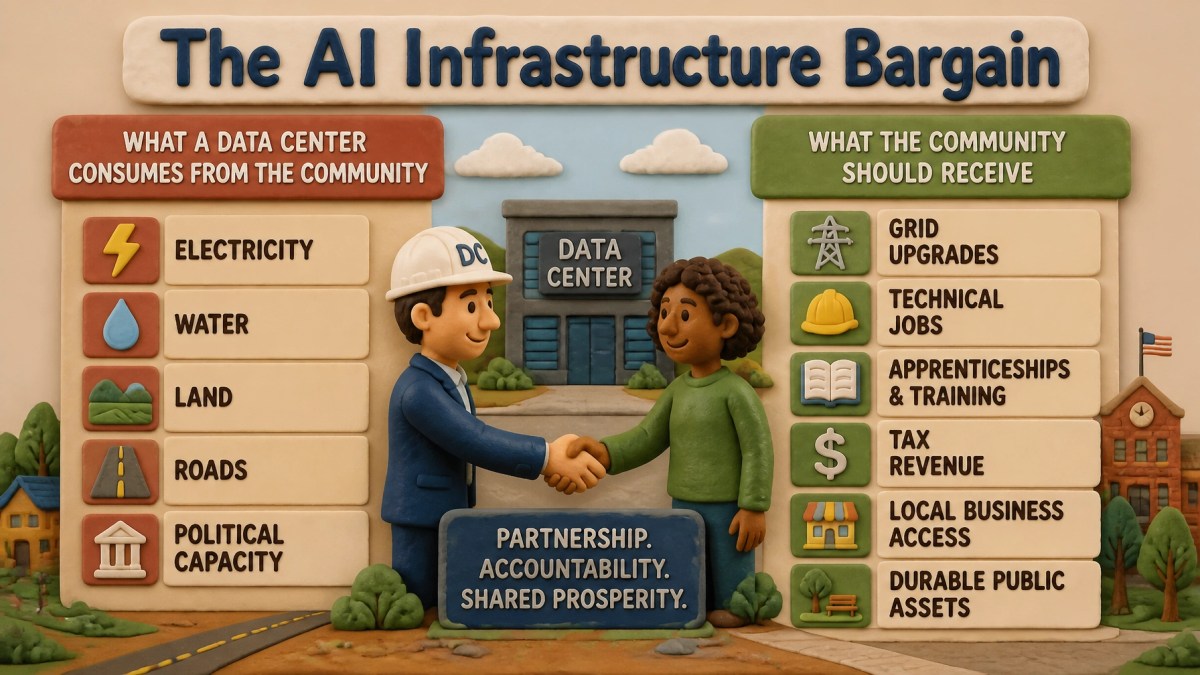
A data center does not arrive alone. It needs a connection to the electric grid, often at a scale that requires new substations, transmission work, backup generation, water systems, roads, fire protection, and public administration. The developer may pay part of that bill while households absorb the remainder through rates, taxes, foregone alternatives, or years of administrative work.
“The project pays taxes” does not settle the question. Tax revenue is a benefit, not an accounting of the marginal cost created by the facility. A town can collect property taxes and still leave households responsible for grid upgrades, road repairs, water stress, or a stranded substation if the operator scales back. The right answer is a public infrastructure compact negotiated before approval, with the company paying for the capacity its demand requires.
Pennsylvania’s August 2026 executive order offers a clearer test. For data centers above 25 megawatts, the state’s Governor’s Responsible Infrastructure Development standards call for developers to provide or purchase the capacity they require and cover associated interconnection, transmission, distribution, network-upgrade, and dedicated-facility costs, according to POWER magazine and Spotlight PA. The order also removes data centers from the state’s Fast Track permitting program and requires local approvals before state permits move forward.
Oklahoma’s 2026 ratepayer protection law follows the same logic by requiring large-load AI projects to fund their own grid upgrades rather than shifting those costs to residential and commercial customers, according to Build Inc.. The cited 2026 policy comparison describes similar provisions in Florida. New York’s Executive Order 62 pauses certain state permits for facilities at or above 50 megawatts while the state studies environmental effects and considers a fund that would assign grid-improvement costs to data centers.
These policies differ in legal form, yet they answer the same public fear: a private company receives the upside while the utility system spreads the downside across customers who never consented to the deal. Ratepayer protection is the first clause in the social contract.
The argument for American leadership deserves a direct answer. Slowing construction can mean less investment, fewer jobs, weaker scientific capacity, and less influence over the systems other countries adopt. Speed matters, and a project that asks families to subsidize private infrastructure creates the backlash that makes the next project harder to approve. The compact is how technology companies protect speed: they make the bargain legible before opposition hardens.
What remains after the ribbon cutting?
Construction employment creates a vivid opening scene. Cranes rise, contractors arrive, hotels fill, and local businesses see a temporary surge in demand. Those gains can be real. They also end.
The operating phase has a different employment profile. A January 2026 economic study prepared by the Southwest Regional Development Commission for a proposed Nobles County, Minnesota, data center estimated thousands of construction jobs alongside more than 80 permanent positions. The report was commissioned for the project’s developer and relied on preliminary assumptions, so its figures should be treated as a local scenario rather than an industry average. Its basic distinction remains important: the largest employment number may belong to the phase that disappears first.
The Guardian’s reporting from Ohio makes the same distinction through a different proposal, citing 35,000 construction jobs and 2,500 long-term operating jobs. The Independent’s account of a $16 billion Michigan project describes more than 2,500 union construction jobs and roughly 450 permanent positions. These are substantial projects with their own plans; they do not justify a generic promise that every data center will produce a local economic renaissance.
The better question is what survives ten years later. Does the town have a stronger electric system that also serves households? Did a community college build a technical program that continues after the original contractor leaves? Did local suppliers gain capabilities that let them win work elsewhere? Did new tax revenue support schools, childcare, housing, or emergency services in a way residents can trace?
A fenced facility may produce tax revenue without producing local capacity. Those are different things. The Data Center Value Timeline separates the temporary construction surge from operating benefits and the durable assets that should carry the public bargain into the next decade.
That distinction should change how economic development agreements are written. Developers and local governments should report construction employment separately from permanent employment, distinguish direct jobs from indirect estimates, and publish what portion of the work went to local firms. Projections should not be allowed to blur into promises.
Who gets to participate?
The right process begins before a site is announced. A technology company should publish a community infrastructure compact before seeking approval: expected peak electricity demand, water source and consumption, cooling design, backup generation, land footprint, tax arrangements, construction schedule, permanent staffing, and the infrastructure costs it will assume. Security requirements may protect sensitive systems; they do not excuse withholding the facts a town needs to judge the deal.
The company should pay the marginal costs its project creates. That means generation, transmission, distribution, interconnection, water, roads, and emergency capacity—not a vague promise that tax revenue will eventually compensate the public. If an upgrade serves the wider grid, the agreement should say how much the company pays, who else gains access, and when that capacity comes online.
The workforce plan should begin before construction peaks. Operators should fund apprenticeships with unions and community colleges, tied to actual requirements in electrical systems, cooling, controls, network operations, maintenance, and safety. They should publish enrollment, completion, local-hire, and retention numbers, then keep the training route open after the facility starts operating.
The company should also leave behind access to the economy it is helping build. A regional university should receive compute for research; local startups and suppliers should receive technical support, credits, or structured access to tools; and utilities should invest in upgrades that improve service for households and small firms. These are durable economic assets. A sponsorship check is not.
The commitments belong in a public agreement with dates, owners, independent verification, and remedies. In Michigan, The Independent reported that a settlement tied to a proposed project included roughly $14 million for farmland preservation, fire services, limits on water use, and noise controls. That kind of negotiated term gives residents protection for what they already have while defining what the new project owes them.
Who carries the risk?
A developer’s return model can price land, electricity, equipment, financing, and construction delays. It may not price the family whose utility bill rises, the farmer competing for water, the school district absorbing new demand, or the township that must defend a zoning decision in court. Those risks remain public even when the project’s capital is private.
There is also the risk of reversal. Demand forecasts can change. A customer can cancel a lease. A project can be reduced after a utility has begun building capacity. In Ohio, local officials told The Guardian that the proposed project was connected to a broader political and investment arrangement whose future could be affected by a change in federal policy. Long-lived infrastructure creates a long-lived exposure to short political cycles.
The answer is a public operating agreement, not a public-relations campaign. It should publish energy and water assumptions, cost allocations, local hiring and training targets, construction milestones, tax abatements, housing and emergency-service plans, and the person responsible for each obligation. It should also state what happens when the operator misses a deadline: additional payments, clawbacks, curtailed demand, or other remedies available under the law.
Public consent must remain revisable. A single zoning hearing cannot settle a thirty-year relationship, so communities need scheduled reviews, operating data, independent verification, and a standing forum with the company, utility, local government, workers, and residents. The company should report quarterly against the compact and renegotiate when demand, water use, technology, or public costs change.
The backlash is rational because the bargain has often been presented as irreversible for the community and flexible for the company. Newsweek’s reporting describes developers responding to concern with generalities, while residents ask for numbers. That information gap invites suspicion, and suspicion travels quickly from one town to the next.
The national AI race will not be won by treating every local objection as ignorance or obstruction. A project that leaves ratepayers exposed, consumes scarce water without clear limits, or offers temporary work in place of durable capacity will generate the resistance that slows the national buildout. Technology companies should treat the compact as part of the project’s core design, because public trust is an operating asset, not a communications line item.
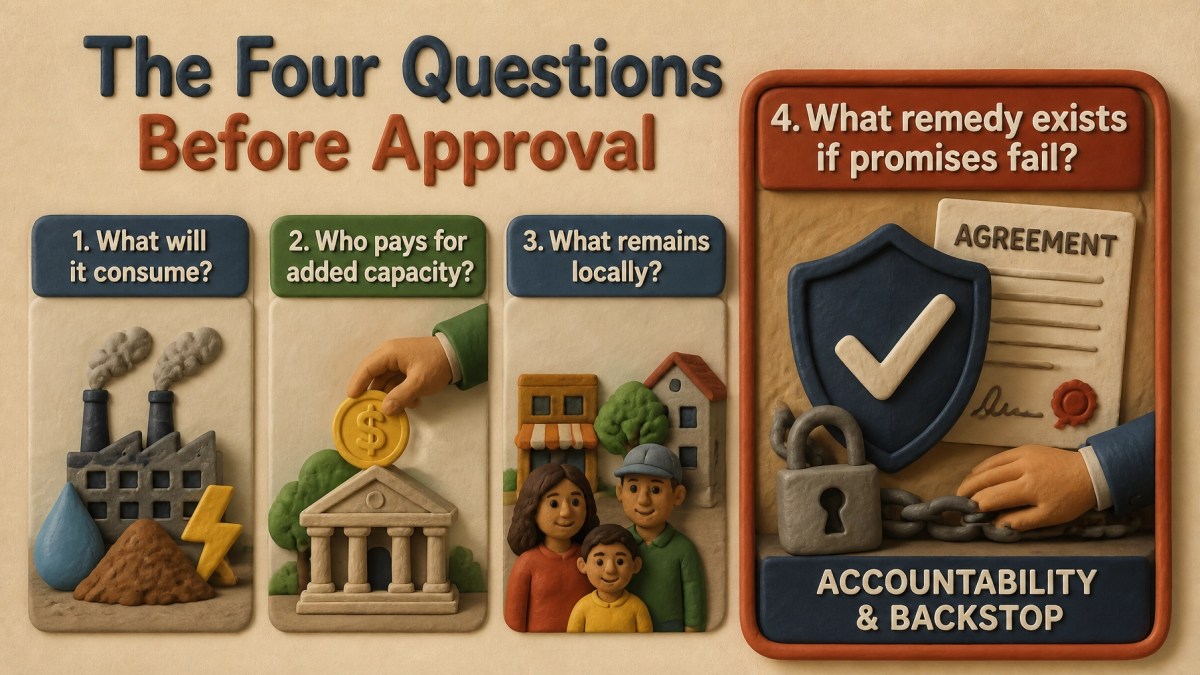
A resident, utility regulator, school board member, or local business owner should be able to answer four questions before approval:
- What will this facility consume?
- Who will pay for the added capacity?
- What durable asset will remain locally?
- What remedy exists if the promise is not met?
If the answers are vague, the proposal is not ready for approval, regardless of how large the investment number appears.
Frequently asked questions
Does opposition to data centers threaten American AI leadership?
Some projects will be delayed, and poorly structured proposals may be rejected. That cost is real. The larger risk comes from approving facilities that shift costs to ratepayers or leave host communities with little durable capacity, because each failed bargain gives opponents stronger evidence and makes later projects more difficult.
Should data centers pay all infrastructure costs?
They should pay the marginal costs caused by their demand, including the generation, transmission, distribution, interconnection, and reliability investments required to serve the facility. Public infrastructure may still provide wider benefits, but regulators should identify those benefits separately rather than assigning the entire bill to households and small businesses.
What should count as a community benefit?
A community benefit should have a defined recipient, funding source, timeline, and verification method. Grid upgrades that improve local reliability, technical training tied to available jobs, apprenticeships, public-service capacity, local supplier programs, and transparent tax payments are stronger than one-time sponsorships because they can continue after construction ends.
Can companies protect security while disclosing project information?
Yes. Operators can keep sensitive details about physical security, network architecture, and proprietary systems confidential while publishing peak electricity demand, water use, cooling methods, backup generation, land footprint, tax arrangements, local hiring targets, and infrastructure obligations. Public confidence depends on access to decision-relevant facts, not unrestricted access to the facility.
Related reading
Board and C-Suite AI Advisory
Liat works directly with boards and executive teams on AI strategy, governance, and investment decisions.


